Haggadot.com is now Recustom!
All your favorite Passover content from Haggadot.com is now here.
Explore Commentary
Mix-and-match
Explore content in our extensive library and pull it together into your own Jewish ritual booklet that honors and recognizes whatever life has brought your way.
Share a ritual
Add your own original content as a clip to our extensive library - a poem, blessing, or something else entirely. Someone out there is looking for exactly what only you can create.
Support us
with your donation.
Help us build moments of meaning and connection through home-based Jewish rituals.
Featured ritual books

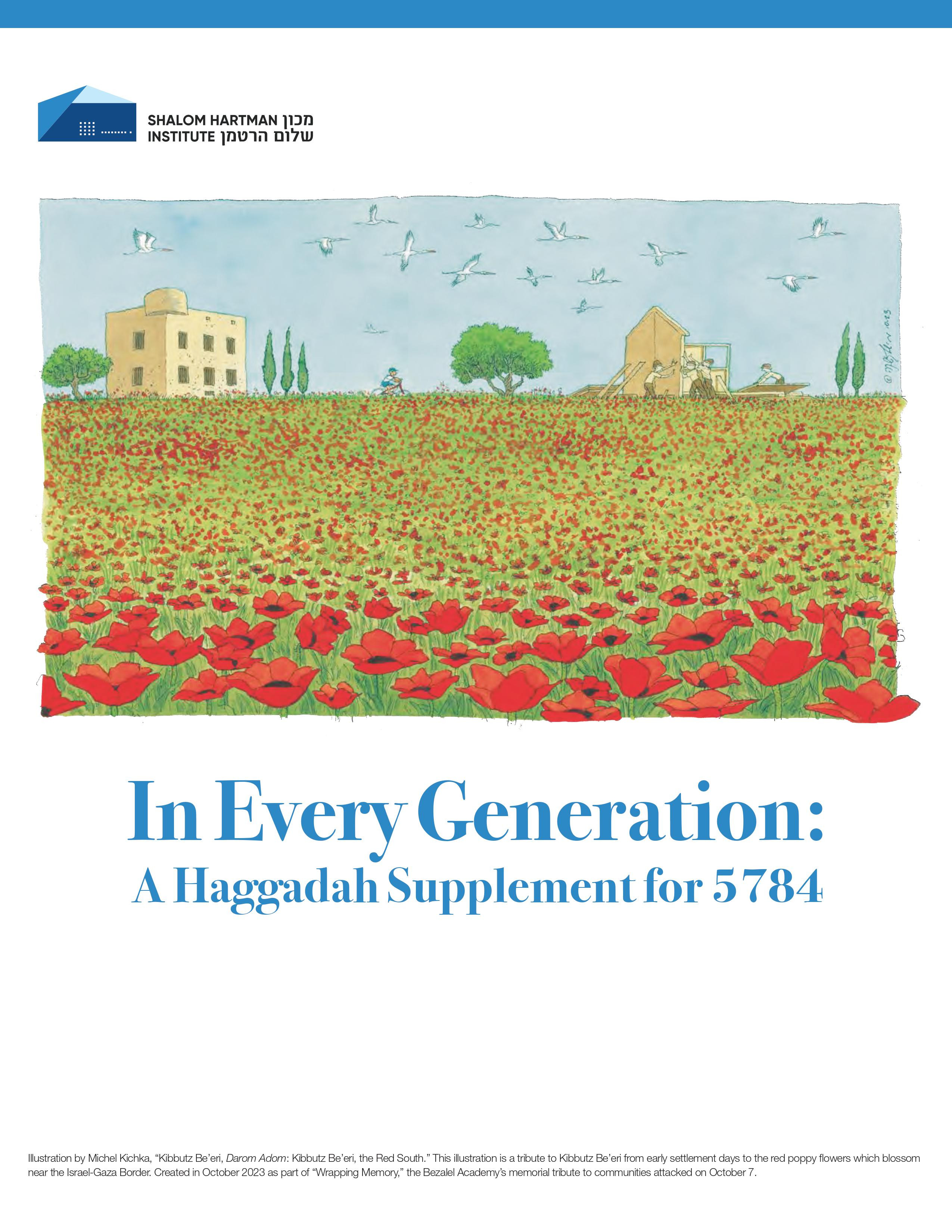
In Every Generation: A Haggadah Supplement for 5784
Preview

The EstherK 2020 Haggadah
Preview
Featured clips
In the early 1980s, the Hillel Foundation invited me to speak on a panel at Oberlin College. While on campus, I came across a Haggadah that had been written by some Oberlin students to express feminist concerns. One ritual they devised was placing a crust of bread on the Seder plate, as a sign of solidarity with Jewish lesbians, a statement of defiance against a rebbetzin’s pronouncement that, “There’s as much room for a lesbian in Judaism as there is for a crust of bread on the seder plate.”
At the next Passover, I placed an orange on our family's Seder plate. During the first part of the Seder, I asked everyone to take a segment of the orange, make the blessing over fruit, and eat it as a gesture of solidarity with Jewish lesbians and gay men, and others who are marginalized within the Jewish community.
Bread on the Seder plate brings an end to Pesach-- it renders everything chametz. And it suggests that being lesbian is being transgressive, violating Judaism. I felt that an orange was suggestive of something else: the fruitfulness for all Jews when lesbians and gay men are contributing and active members of Jewish life. In addition, each orange segment had a few seeds that had to be spit out--a gesture of spitting out, repudiating the homophobia of Judaism.
When lecturing, I often mentioned my custom as one of many new feminist rituals that have been developed in the last twenty years. Somehow, though, the typical patriarchal maneuver occurred:
My idea of an orange and my intention of affirming lesbians and gay men were transformed. Now the story circulates that a man said to me that a woman belongs on the bimah as an orange on the Seder plate. A woman's words are attributed to a man, and the affirmation of lesbians and gay men is simply erased.
Isn't that precisely what's happened over the centuries to women's ideas? And isn’t this precisely the erasure of their existence that gay and lesbian Jews continue to endure, to this day?
- Excerpted from an Email from Professor Susannah Heschel
Susannah Heschel Explains the Orange
Preview
More
1. What do you consider your “promised land,” or heaven on earth?
2. In Hebrew, the word for Egypt is “Mitzraim,” which literally means “narrow place.” What is one way that you wish for our society to be more open?
3. Moses is considered one of the greatest leaders in our history — he is described as being smart, courageous, selfless and kind. Which of today’s leaders inspires you in a similar way?
4. Miriam was a prophetess and the sister of Moses who, after crossing the Red Sea, led the women in song and dance with tambourines. She is described as being courageous, confident, insightful and nurturing. Which musician or artist today inspires you in a similar way?
5. More recent and ongoing struggles for freedom include civil rights, GLBTQ equality, and women’s rights. Who is someone involved in this work that you admire?
6. Is there someone — or multiple people — in your family’s history who made their own journey to freedom?
7. Freedom is a central theme of Passover. When in your life have you felt most free?
8. If you could write an 11th commandment, what would it be?
9. What’s the longest journey you have ever taken?
10. How many non-food uses for matzah can you think of? Discuss!
11. Let’s say you are an Israelite packing for 40 years in the desert. What three modern items would you want to bring?
12. The Haggadah says that in every generation of Jewish history enemies have tried to eliminate us. What are the biggest threats you see to Judaism today?
13. The Passover seder format encourages us to ask as many questions as we can. What questions has Judaism encouraged you to ask?
14. Israel is central to the Passover seder. Do you think modern Israel is central to Jewish life? Why or why not?
15. The manna in the desert had a taste that matched the desire of each individual who ate it. For you, what would that taste be? Why?
16. Let’s say you had to swim across the Red Sea, and it could be made of anything except water. What would you want it to be?
17. If the prophet Elijah walked through the door and sat down at your table, what’s the first thing you would ask him?
18. Afikoman means “dessert” in Greek. If you could only eat one dessert for the rest of your life, what would it be?
19. What is something you wish to cleanse yourself of this year? A bad habit? An obsession or addiction?
20. The word “seder” means “order.” How do you maintain order in your life?
---
Download the PDF here: https://www.jewishboston.com/20-table-topics-for-your-passover-seder/
By Rabbi Kerry M. Olitzky and Liz Offenbach
Whether in prayer or conversation, the words we use are not taken lightly in Judaism, especially when they are harmful to others. Jewish law actually likens the act of embarrassing a person to murder. And the Talmud, the primary source book for Jewish law, teaches that gossiping is equivalent to the murder of three people.
As you sit around the Passover seder table this year, be conscious of the words you use to describe others. Consider their impact because all too often we forget that words have the power to marginalize and oppress members of our society.
This holiday, we invite you to make this pledge and bring it your seder table: "I promise to the best of my ability to eliminate from my vocabulary all words that are hurtful, insensitive and oppressive of others, and include only words that are welcoming, sensitive and liberating."
Language defines us. It shapes who we are. Language can build, but it also has the potential to destroy through the extension and perpetuation of negative stereotypes. We are not “kikes”; we are not “cheap Jews.” We bristle even at the mention of such words.
Similarly, those from other religious backgrounds who have chosen to cast their lot with the Jewish people through marriage are not “shaygetzes” or “shiksas,” “intermarrieds” or “goys.” They are women and men. They are Christians, Muslims, Buddhists and atheists. They do not “desecrate” nor are they “abominations.”
During Passover, Jews and their loved ones recount the story of the Exodus and recite, “Now we are slaves, next year may we be free.” This verse, from the “Ha Lachma Anya" (The Bread of Our Affliction) Passover table reading, is both symbolic and literal. During the seder we put ourselves in the place of the Israelite slaves, but we also remember those in other parts of the world who today live without freedom. We are fortunate to live in a democracy where we can say and think whatever we choose, so let’s use this upcoming holiday as an opportunity to choose words that will free people rather than enslave them.
When we choose to eliminate such language from our speech, we are able to welcome and include all those who wish to engage with Judaism in our Big Tent. Sometimes “negative language” is not obvious to all. What is negative to one person may appear to be positive to another. And some words have evolved to take on positive and empowering connotations when once they were negative and demeaning. For example, “queer” was once used as a derisive term to refer to gay individuals. Today it represents a term of empowerment.
This is something we are all learning. Even at the Jewish Outreach Institute, where we try to be inclusive of all, we recently received feedback about an article we had written that mistakenly compared those with mental and physical disabilities to those who are “well.” Did we mean to imply that people with disabilities are therefore “unwell” and somehow less robust and dynamic members of the community? Of course not. We erred and have since apologized. We continue to learn.
This Passover, we ask that you do your best to end the “enslavement” of others through language. We are well aware of the grave nature of physical slavery, and we are not making light of this serious issue by raising the concern of verbal oppression. But it’s clear through our work that using negative language makes some people feel like they are being relegated to a lower or outer edge of society.
Now is the time to stop defining those who are different from us by using negative words and stereotypes -- whether different means Jewish or another religious background, heterosexual or homosexual, American or any other ethnic group, disabled, male or female, single or married, old or young.
Inclusive language is the first step toward creating a truly inclusive -- and fully free from oppression -- Jewish community.
(Rabbi Kerry M. Olitzky is the executive director of the Jewish Outreach Institute (JOI.org) and the author of many books, including "Preparing Your Heart for Passover: A Guide for Spiritual Readiness." Liz Offenbach is the director of program at the institute.)
At Seder Table, Pledge Exodus from Negative Language
Preview
More

showing
1-6
of
18
Page
1
of
3