Mix-and-match
Explore content in our extensive library and pull it together into your own Jewish ritual booklet that honors and recognizes whatever life has brought your way.
Share a ritual
Add your own original content as a clip to our extensive library - a poem, blessing, or something else entirely. Someone out there is looking for exactly what only you can create.
Support us
with your donation.
Help us build moments of meaning and connection through home-based Jewish rituals.
Featured ritual books
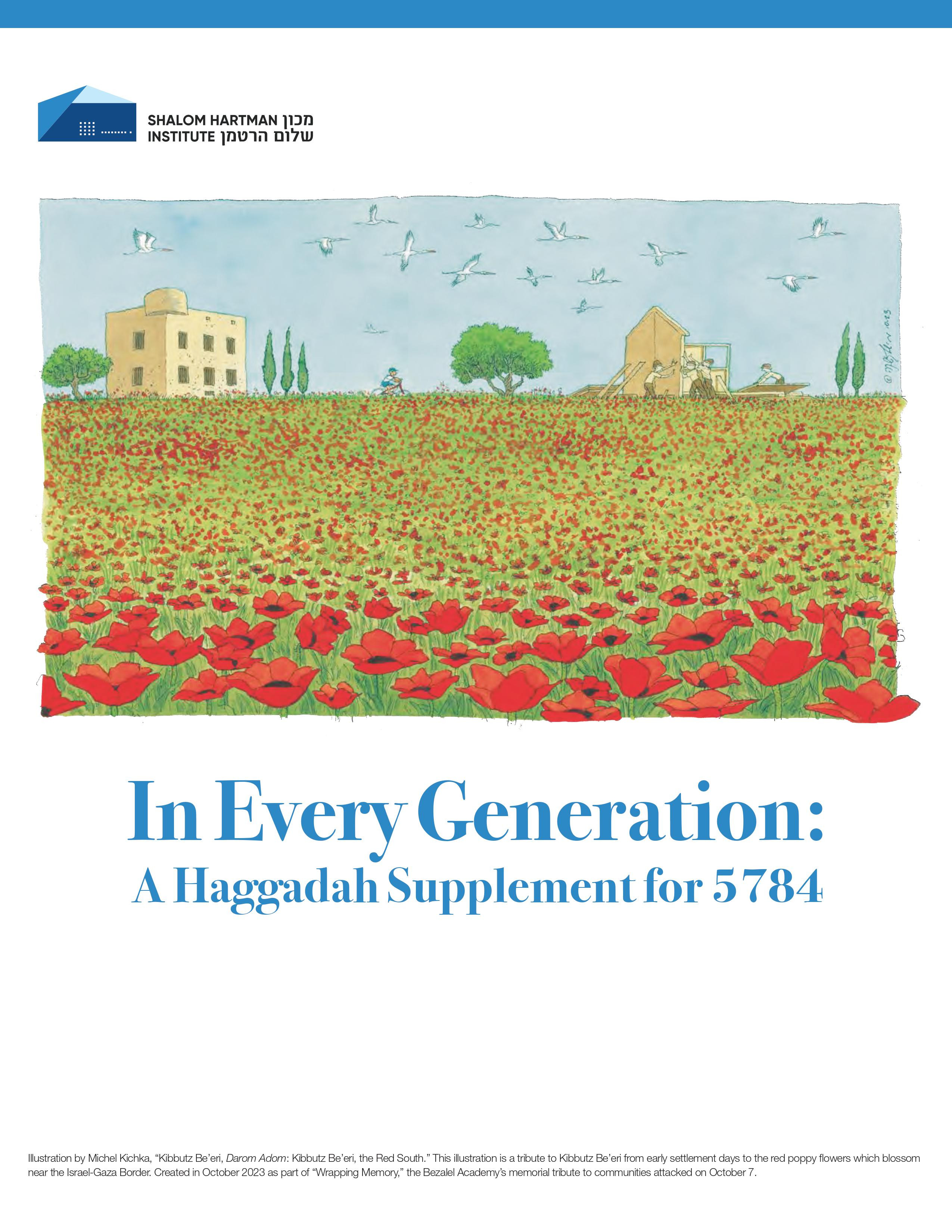
In Every Generation: A Haggadah Supplement for 5784
Preview
Featured clips
Researchers have begun to establish a causal link between storytelling and thriving. In 2001, psychologists Marshall Duke and Robyn Fvush compared children's psychological health with their knowledge of their own family history. They measured this knowledge on a "Do You Know?" scale. This scale turned out to be the best single predictor of children's emotional health and happiness.
The more children knew their family's history, the stronger their sense of control over their lives, the higher their self-esteem, and the more successfully they believed their families functioned.
Two months after this study was conducted, the September 11 attacks occurred. The psychologists went back and studied how the same group of children responded to that trauma. The results were the same: "The ones who knew more about their families proved to be more resilient, meaning they could moderate the effects of stress."
To explain the connection between story and resilience, the psychologists coined the term ‘intergenerational self.’ It's a sense that you're part of something bigger, that your life is an episode in a larger narrative. More than just entertain and amuse, (which they do) cross-generational stories serve another purpose.
Family stories let children know that they're not alone, and that those who came before them celebrated triumphs and overcame struggles, just as they do.
Additionally, in a study of family stories at Emory University, it was found that family stories seem to be transferred by mothers and grandmothers more often than not, and that the information was typically passed during family dinners, family vacations and family holidays. Other data indicated that these very same regular family dinners, vacations, and holiday celebrations occur more frequently in families that have high levels of cohesiveness. It is the ‘intergenerational self’ and the personal strength that is derived from it that are associated with increased resilience, better adjustment, and improved chances of good clinical and educational outcomes.
The researchers define three types of family narratives:
1. The ascending narrative: we came from nothing and now we've succeeded (rags to riches).
2. The descending narrative: we used to have it all and now we have nothing.
3. And, the most healthful narrative is called the oscillating family narrative: we've had ups and downs, and we've persevered, as a family.
This third narrative is the story of the Jewish people.
When we share stories - especially over holidays - year after year after year, we invite the next generation into the Jewish family story. Our stories are still unfolding.
Building Resilience Through Family Stories
Preview
More
Coming through the sea was only the beginning.
The giddiness of walking through walls of living water...
But the story doesn’t end there.
Now it’s desert, without a map.
What if the next forty years are bone-dry and desolate?
Maybe it wasn’t so bad, that life numb and familiar.
Cucumbers and fish fresh from the Nile.
Certainty: a fixed path.
Now hope unfolds its mighty wings and every step risks failure.
When I falter, remind me I didn’t cross the sea alone.
Remind me there’s a mountain I’m heading toward,
a promise that spans lifetimes of becoming, together, with you.
בָּ רוֹּךְ אַתָּ ה יי גָּאַל יִשְ ׂרָאֵל
Baruch atah YHVH ga’al Yisrael.
Blessed are You, YHVH, redeemer of Israel.
Once upon a time, during a famine our ancestor Jacob and his family fled to Egypt where food was plentiful. His son Joseph had risen to high position in Pharaoh’s court, and our people were well-respected and well-regarded, secure in the power structure of the time.
Generations passed and our people remained in Egypt. In time, a new Pharaoh ascended to the throne. He found our difference threatening, and ordered our people enslaved. In fear of rebellion, Pharaoh decreed that all Hebrew baby boys be killed. Two midwives named Shifrah and Puah defied his orders. Through their courage, a boy survived; midrash tells us he was radiant with light. Fearing for his safety, his family placed him in a basket and he floated down the Nile. He was found, and adopted, by Pharaoh’s daughter, who named him Moses because she drew him forth from the water. Thanks to Moses' sister Miriam, Pharaoh's daughter hired their mother, Yocheved, as his wet-nurse. Thus he survived to adulthood, and was raised as Prince of Egypt.
Although a child of privilege, as he grew he became aware of the slaves who worked in the brickyards of his father. When he saw an overseer mistreat a slave, Moses struck the overseer and killed him. Fearing retribution, he set out across the Sinai alone. God spoke to him from a burning bush, which though it flamed was not consumed. The Voice called him to lead the Hebrew people to freedom. Moses argued with God, pleading inadequacy, but God disagreed. Sometimes our responsibilities choose us.
Moses returned to Egypt and went to Pharaoh to argue the injustice of slavery. He gave Pharaoh a mandate which resounds through history: Let my people go. Pharaoh refused, and Moses warned him that Mighty God would strike the Egyptian people. These threats were not idle; ten terrible plagues were unleashed upon the Egyptians. Only when his nation lay in ruins did Pharaoh agree to our liberation.
Fearful that Pharaoh would change his mind, our people fled, not waiting for their bread dough to rise. Our people did not leave Egypt alone; a “mixed multitude” went with them. From this we learn that liberation is not for us alone, but for all the nations of the earth. Even Pharaoh’s daughter came with us.
Pharaoh’s army followed us to the Sea of Reeds. We plunged into the waters. Only when we had gone as far as we could did the waters part for us. We mourn, even now, that Pharaoh’s army drowned: our liberation is bittersweet because people died in our pursuit. To this day we relive our liberation, that we may not become complacent, that we may always rejoice in our freedom.

Story of Moses - a memo from Moses to G-d
Preview
More
showing
1-6
of
18
Page
1
of
3