Mix-and-match
Explore content in our extensive library and pull it together into your own Jewish ritual booklet that honors and recognizes whatever life has brought your way.
Share a ritual
Add your own original content as a clip to our extensive library - a poem, blessing, or something else entirely. Someone out there is looking for exactly what only you can create.
Support us
with your donation.
Help us build moments of meaning and connection through home-based Jewish rituals.
Featured clips
Gathered here in warmth and light,
We share in ancient stories tonight.
From hands both new and weathered with time,
We weave tradition's rich design.
For some, these customs feel like home—
The wine, the food, the sacred tome.
For others, fresh to Passover's ways,
These rituals spark wonder's blaze.
From Egypt's chains to freedom's shore,
We tell a tale told countless times before.
Yet each retelling brings insight anew,
A sparkle fresh as morning dew.
"Seder" means order, a path we'll trace
Through this evening's gathering, at our own pace.
Questions welcome, voices clear—
So ask away, all who gather here.
We'll break the matzah, sip the wine,
Taste bitter and sweet combine.
Each symbol holds a story true
Of freedom's journey, old and new.
So whether first or fiftieth year
You've joined our celebration here,
Tonight we all from Egypt flee—
Each soul discovering what it means to be free.
Let peace and joy fill every heart
As we prepare for our Seder to start.
For freedom's call still rings today,
And so we begin—now let us pray.
“When will I be myself again?”
Some Tuesday, perhaps,
In the late afternoon,
Sitting quietly with a cup of tea
And a cookie;
Or Wednesday, same time or later,
You will stir from a nap and see her;
You will pick up the phone to call her;
You will hear her voice – unexpected advice –
And maybe argue.
And you will not be frightened,
And you will not be sad,
And you will not be alone,
Not alone at all,
And your tears will warm you.
But not today,
And not tomorrow,
And not tomorrow’s tomorrow,
But someday,
Some Tuesday, late in the afternoon,
Sitting quietly with a cup of tea
And a cookie
And you will be yourself again.
Shared by Bayit, Beside Still Waters
In the Time of our Sorrow
By Rachel Kann
My tongue wants to un-gate the flood, it is
an urgent compulsion to spill knotted guts,
in these weeks of banned melody,
my lips wants to rebel,
to howl,
to sing
of my suffering,
of all my shortcomings,
every rejection,
every threat to our collective existence,
the abandonment unabated,
of how my heart is a bitter almond,
spilling with cyanide,
splitting its endocarp,
longing only for the orchard,
of how my heart is a heavy stone,
flack-jacketed,
sallow and sinking in my chest,
how a glut of shrapnel is stuck in my throat,
of how I am blindfolded in love’s minefield,
frozen, unable to navigate the danger
lurking beneath the surface,
hurtful blossoms
lying in night-wait
only to explode,
detonate the light of day,
of the world’s unending
re-dedication to the re-destruction
of temples.
My heart wants to take flight,
transcend the gravity
of this misbegotten planet.
Before the unkindness of ravens and
murder of crows can escape the open moan,
I am circle-dancing,
hand in hand with so many wondrous
warrior women,
with Magda and Miriam,
who came through the dark tunnel of the Shoah,
who are here with me,
present and spilling light.
This is beyond awe,
beyond gratitude.
We weave a grapevine
up the trunk of the almond tree,
we are strengthened by our suffering.
We are indestructible.
This world crushes us,
we refuse to turn poisonous,
dancing and rooting and branching
despite this.
In glorious defiance,
we pour ourselves forward
in honeyed amaretto flooding,
we sweeten the darkness,
light the bitterness.
We kasher every unholy implement
used against us.
We ready them for service
in the holy temple of our most
miraculous dance:
our continued existence.
The Seder is all about answering questions. But one question remains unanswered, and that’s the most important question – Why? We are taught, “In every generation, each person must see him/herself as if s/he were redeemed from Egypt.” But why? Why return to Egypt year after year? Why re-taste the bitterness of slavery? Ask the Torah – What difference does this experience make for me? How am I shaped by the experience of slavery and liberation? Here is the Torah’s response…Out of Exodus comes a fully-formed social vision, an ethic, and way of looking at history. Read each verse, and ask how the experience of Egypt shapes us, shapes our behavior, our society, our expectations for the world. This is the missing page from the Haggadah, the answer to Why?
Exodus 22:20 -- You shall not wrong a stranger or oppress him, for you were strangers in the land of Egypt. You shall not ill-treat any widow or orphan.
Exodus 23: 5 -- When you see your enemy’s mule lying under its burden and would refrain from raising it, you must nevertheless raise it with him. You shall not subvert the rights of your needy in their disputes. ... You shall not oppress a stranger for you know the soul of the stranger having yourselves been strangers in the land of Egypt.
Leviticus 19:33 -- When a stranger resides with you in your land, you shall not wrong him. The stranger who resides with you shall be to you as one of your citizens; you shall love him as yourself, for you were strangers in the land of Egypt.I the Lord am your God.
Leviticus 25:35 -- If your kinsman, becomes poor, and his means fail, then you shall uphold him, you shall hold him as though a resident alien, let him live by your side: do not exact from him advance or accrued interest, but fear your God. Let him live by your side as your kinsman. Do not lend him money at advance interest or give him your food at accrued interest. I the Lord am your God, who brought you out of the land of Egypt to give you the land of Canaan, to be your God.
Deuteronomy 5:12-15 -- Observe the Sabbath day and keep it holy, as the Lord your God has commanded you. Six days you shall labor and do all your work, but the seventh day is a sabbath of the Lord your God; you shall not do any work -- you, your son or your daughter, your male or female slave, your ox or your ass, or any of your cattle, or the stranger in your settlements so that your male and female slave may rest as you do. Remember that you were a slave in the land of Egypt and the Lord your God freed you from there with a mighty hand and an outstretched arm; therefore the Lord your God has commanded you to observe the Sabbath day.
Deuteronomy 10:17 -- God shows no favor and takes no bribe but upholds the cause of the fatherless and the widow and befriends the stranger providing him with food and clothing. You too must befriend the stranger, for you were strangers in the land of Egypt.
Deuteronomy 24:17ff -- You shall not subvert the rights of the stranger or the fatherless; you shall not take a widow's garment in pawn. Remember that you were a slave in Egypt and that the Lord your God redeemed you from there; therefore do I enjoin you to observe this commandment.
When you reap the harvest in your field and overlook a sheaf in the field, do not turn back to get it; it shall go to the stranger, the fatherless, and the widow -- in order that the Lord your God may bless you in all your undertakings. When you beat down the fruit of your olive trees, do not go over them again, this shall go to the stranger, the fatherless and the widow. When you gather the grapes of your vineyard, do not pick it over again; that shall go to the stranger, the fatherless, and the widow. Always remember that you were a slave in the land of Egypt; therefore do I enjoin you to observe this commandment.
Exodus 20:1-2 -- I am the LORD your God who brought you out of the land of Egypt, the house of bondage. You shall have no other gods besides Me.
Passover is a holiday with many different themes. This breadth ensures that no two seders will ever be exactly alike and encourages each of us to engage equally, whether this is the first or hundredth seder you’ve attended. It also challenges each of us to connect to the seder on a personal, individual level. The themes offered are just a sampling, what other themes are you drawn to?
Redemption: In the Exodus story, the Jews were redeemed physically from slavery. While Pesach is "z'man heyruteinu," the season of our freedom, it is also a festival that speaks of spiritual redemption. Jews were freed from mental as well as physical slavery. It was as a physically and spiritually free people that the Jewish nation prepared to receive the Torah on Mt. Sinai. The seder also includes many allusions to a future messianic redemption. One of the clearest symbols is the Cup of Elijah placed on every seder table. Contained within the salvation from Egypt are the seeds of future redemption, as the Torah states, "This same night is a night of watching unto the Lord for all the children of Israel throughout their generations" (Exodus 12:42).
Creation: Passover is known by several names in Hebrew, including Chag HaAviv, holiday of the spring. Pesach celebrates spring, rebirth, and renewal, symbolized by the green “karpas” and the egg on the seder plate. It is also a time of “beginning,” as exemplified by the first grain harvest and the birth of Israel as a nation. Also, Nissan, this Hebrew month, was traditionally seen as the first month of the Jewish year.
Education: Four different times in the Torah, the Jews are commanded to repeat the story of the Passover (Exodus 12:26, 13:8, 14; Deuteronomy 6:20). The seder is centered around teaching the story of the exodus from Egypt. In fact, Haggadah means “the telling.” Two of the most important readings address education head on: the four questions and the four sons. The first encourages even the youngest children to begin asking questions, while the latter instructs us how to respond to different learning styles. Even at a seder without children present, the night takes on an educational feel. Thought provoking questions and supportive debate are encouraged.
Patterns of Four: Throughout the seder, you may notice the number four being repeated in many guises. This is based on the verse in Exodus that states, "I am the Lord, and I will bring you out from under the burdens of the Egyptians, and I will deliver you from their bondage, and I will redeem you with an outstretched arm and with great judgments, and I will take you to Me for a people, and I will be to you a God…" (Exodus 6:6-7). Among many other patterns of four at the seder, we drink four cups of wine, ask four questions, and speak about four types of children.
showing
1-6
of
9
Page
1
of
2
Featured ritual books
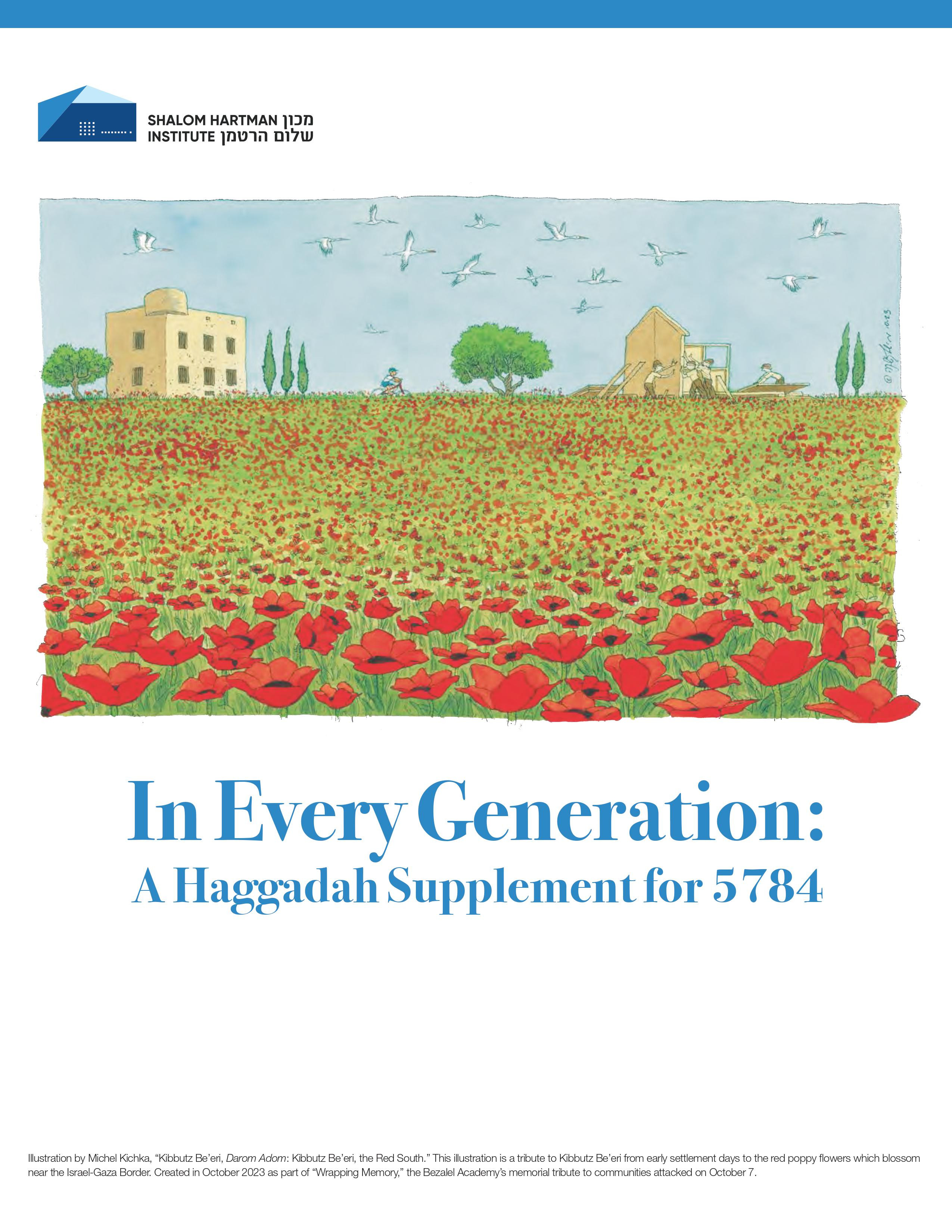
In Every Generation: A Haggadah Supplement for 5784
Preview