Mix-and-match
Explore content in our extensive library and pull it together into your own Jewish ritual booklet that honors and recognizes whatever life has brought your way.
Share a ritual
Add your own original content as a clip to our extensive library - a poem, blessing, or something else entirely. Someone out there is looking for exactly what only you can create.
Support us
with your donation.
Help us build moments of meaning and connection through home-based Jewish rituals.
Featured ritual books
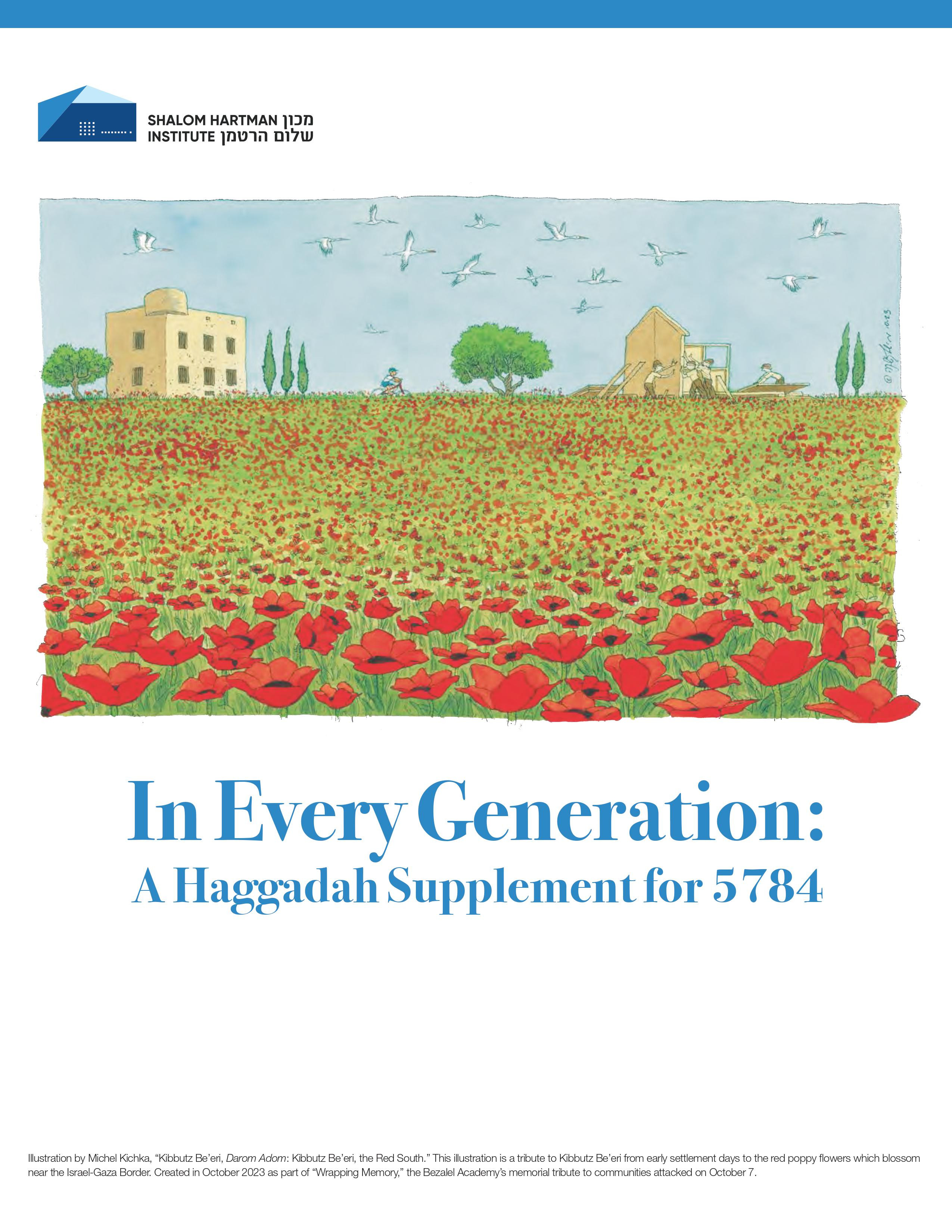
In Every Generation: A Haggadah Supplement for 5784
Preview

Mazon Hunger Seder 2020
Preview
MAZON Hunger Seder 2025
Preview
Mental Health Haggadah Supplement
Preview
Counting the Omer: a Meditation Guide
Preview
showing
1-6
of
3874
Page
1
of
646
Featured clips
Researchers have begun to establish a causal link between storytelling and thriving. In 2001, psychologists Marshall Duke and Robyn Fvush compared children's psychological health with their knowledge of their own family history. They measured this knowledge on a "Do You Know?" scale. This scale turned out to be the best single predictor of children's emotional health and happiness.
The more children knew their family's history, the stronger their sense of control over their lives, the higher their self-esteem, and the more successfully they believed their families functioned.
Two months after this study was conducted, the September 11 attacks occurred. The psychologists went back and studied how the same group of children responded to that trauma. The results were the same: "The ones who knew more about their families proved to be more resilient, meaning they could moderate the effects of stress."
To explain the connection between story and resilience, the psychologists coined the term ‘intergenerational self.’ It's a sense that you're part of something bigger, that your life is an episode in a larger narrative. More than just entertain and amuse, (which they do) cross-generational stories serve another purpose.
Family stories let children know that they're not alone, and that those who came before them celebrated triumphs and overcame struggles, just as they do.
Additionally, in a study of family stories at Emory University, it was found that family stories seem to be transferred by mothers and grandmothers more often than not, and that the information was typically passed during family dinners, family vacations and family holidays. Other data indicated that these very same regular family dinners, vacations, and holiday celebrations occur more frequently in families that have high levels of cohesiveness. It is the ‘intergenerational self’ and the personal strength that is derived from it that are associated with increased resilience, better adjustment, and improved chances of good clinical and educational outcomes.
The researchers define three types of family narratives:
1. The ascending narrative: we came from nothing and now we've succeeded (rags to riches).
2. The descending narrative: we used to have it all and now we have nothing.
3. And, the most healthful narrative is called the oscillating family narrative: we've had ups and downs, and we've persevered, as a family.
This third narrative is the story of the Jewish people.
When we share stories - especially over holidays - year after year after year, we invite the next generation into the Jewish family story. Our stories are still unfolding.
Building Resilience Through Family Stories
Preview
More
The central imperative of the Seder is to tell the story. The Bible instructs: “ You shall tell your child on that day, saying: ‘This is because of what Adonai did for me when I came out of Egypt.' ” (Exodus 13:8) We relate the story of our ancestors to regain the memories as our own. Elie Weisel writes: God created man because He loves stories. We each have a story to tell — a story of enslavement, struggle, liberation. Be sure to tell your story at the Seder table, for the Passover is offered not as a one-time event, but as a model for human experience in all generations.
-
Ha lachma anya d’achaloo avhatana b’ara d’meetzrayeem. Kol dichfeen yay-tay vi’yachool, kol deetzreech yay-tay viyeesfsach. Hashata hach. Li’shana ha-ba-aa bi’arah di’yeesrael. Hashata av’day, li’shana ha-ba a bi’nay choreen.
This is the bread of affliction, which our ancestors ate in the land of Egypt. Let all who are hungry come and eat. Let all who are in need, come and celebrate Passover. Today, we are here. Next year, in the land of Israel. Today, we are slaves. Next year, we will be free.
Written in Aramaic, this statement begins the narration of the Seder by inviting the hungry to our table. Aramaic, Jewish legend has it, is the one language which the angels do not understand. Why then is Ha Lachma spoken in Aramaic? To teach us that where there is hunger, no one should rely upon the angels, no one should pray to the heavens for help. We know the language of the poor, for we were poor in the land of Egypt. We know that we are called to feed the poor and to call them to join our celebration of freedom.
According to the Book of Exodus, there was a famine in the land of Canaan (later known as Israel). Because of this famine, the Hebrew patriarch Jacob traveled with his extended family of 70 to Egypt to both live inbetter conditions and be with his son Joseph. Joseph’s wisdom had impressed the Pharaoh of Egypt to the point that he was appointed Viceroy of Egypt, which was second in power only to the Pharaoh.
The next 430 years in Egypt saw the Israelites prosper and rapidly multiply to about 3 million people. These numbers were so great, the Pharaoh became nervous that the Israelites were becoming too many in number to control and thought they might side with Egypt’s enemies in case of war. The Pharaoh decreed that the Israelites should be enslaved to build cities and roads for him so that they would be too tired and also would not have time to have children. The Israelites were then confined to the land area of Goshen (Hebrew meaning of Goshen: “approaching” or “drawing near,” meaning the Israelites were possibly drawn closer to God during this period of time in Goshen, hence the essence of the Passover story occurred here), which was the fertile land that was east of the Nile delta and west of the border of Canaan.
As slaves, the lives of our ancestors were embittered and our Seder plate symbolically represents their lives under bondage.
How Did the Israelites Wind Up in Egypt in the First Place?
Preview
More
showing
1-6
of
68447
Page
1
of
11408