Mix-and-match
Explore content in our extensive library and pull it together into your own Jewish ritual booklet that honors and recognizes whatever life has brought your way.
Share a ritual
Add your own original content as a clip to our extensive library - a poem, blessing, or something else entirely. Someone out there is looking for exactly what only you can create.
Support us
with your donation.
Help us build moments of meaning and connection through home-based Jewish rituals.
Featured clips
To the One who blessed our ancestors and the
One who blesses all beings here on this earth,
bless all those who are suffering the grief of someone they loved.
May they find solace in their memory,
and may their love find a resting place in their hearts.
Bless all those who are struggling with the death
of someone with whom they had a difficult relationship.
May they find compassion for themselves and renewal of spirit.
May they have patience and strength, as grief can come in waves throughout their lives.
May they find the courage to share their grief with others, no matter how many years have gone by.
While they can be shattered by loss, they can be healed by love from others.
Sacred One, help them find ways to open their hearts to love and hope.
Bless all those who are grieving, for it is an honor to have lived.
Make both life and death a blessing.
Amen.
A prayer by the Blue Dove Foundation
Mi Sheberach for Grief
Preview
More
We believe Jewish prayers and rituals can help to strengthen our mental well-being, resilience and recovery in the same way middot, or Jewish values, can promote them. Faith is an important part of healing for many, and Jewish thinkers and leaders historically have brought the two together. When someone is ill or recovering from illness or an accident, we often recite a misheberach to wish them a refuah sheleimah, or a “full recovery.” We have expanded the prayer for those who are struggling with mental health.
Mi Sheberach for Mental Health:
May the One who blessed our ancestors and named us Israel bless and heal those among us who struggle with mental well-being. May they acknowledge their own strength and resilience, treat themselves with forgiveness and patience, and find help, compassion, and resources when they need them. And, may the Holy One grant those of us who aren’t experiencing mental health issues the strength, resilience and capacity to listen without judgment and with intention, and the ability to notice when others are struggling. May we create communities that accept, uplift, and support those among us who are struggling. Now, speedily, and in a time soon to come. Amen.
The Blue Dove Foundation with Association of Reform Jewish Educators
Mi Sheberach For Mental Health
Preview
More
To the One who blessed our ancestors and the
One who blesses all beings here on this earth,
bless all those who are suffering the grief of someone they loved.
May they find solace in their memory,
and may their love find a resting place in their hearts.
Bless all those who are struggling with the death
of someone with whom they had a difficult relationship.
May they find compassion for themselves and renewal of spirit.
May they have patience and strength, as grief can come in waves throughout their lives.
May they find the courage to share their grief with others, no matter how many years have gone by.
While they can be shattered by loss, they can be healed by love from others.
Sacred One, help them find ways to open their hearts to love and hope.
Bless all those who are grieving, for it is an honor to have lived.
Make both life and death a blessing.
Amen.
A prayer by the Blue Dove Foundation
Mi Sheberach for Grief
Preview
More
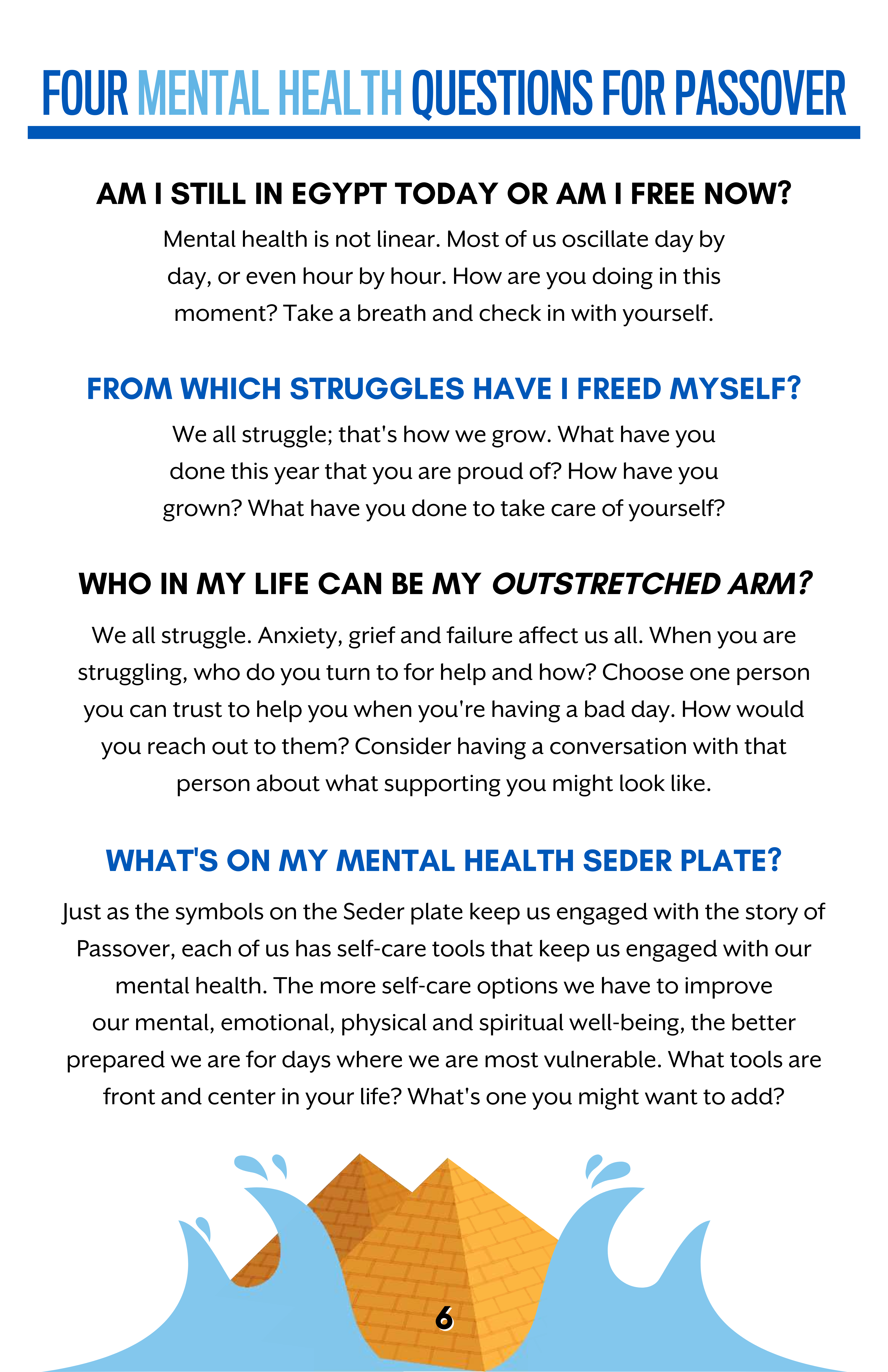
Four Mental Health Questions for Passover
Preview
More
To the One who blessed our ancestors and the
One who blesses all beings here on this earth,
bless all those who are suffering the grief of someone they loved.
May they find solace in their memory,
and may their love find a resting place in their hearts.
Bless all those who are struggling with the death
of someone with whom they had a difficult relationship.
May they find compassion for themselves and renewal of spirit.
May they have patience and strength, as grief can come in waves throughout their lives.
May they find the courage to share their grief with others, no matter how many years have gone by.
While they can be shattered by loss, they can be healed by love from others.
Sacred One, help them find ways to open their hearts to love and hope.
Bless all those who are grieving, for it is an honor to have lived.
Make both life and death a blessing.
Amen.
A prayer by the Blue Dove Foundation
Mi Sheberach for Grief
Preview
More
As we begin retelling the story of our redemption, we take the three pieces of matzah before us, remove the center piece, and split it in half. We eat the first half at the beginning of the Seder and hide the other half, which serves as the afikoman we eat at the conclusion of the Seder. It is worth noting the bread of slavery consumed at the beginning of the Seder and the bread of freedom we eat at the end of the Seder both come from the same piece of matzah.
Sometimes the difference between the things that cause us pain and those that give us pleasure is simply a matter of perspective. When seen through the lens of miraculous redemption and a recognition of the larger picture of our path to freedom, the bread of slavery transforms into the bread of freedom it was always intended to become. We must also remember — or hope — the potential for recovery isinside of us, waiting to be recognized or — like the afikomen — found.
Prompt: What experience in your own life caused you pain but, in hindsight, can be seen as a blessing? Or, if you currently find yourself in the midst of a painful experience, can you try to identify one positive aspect or lesson you can learn from it?
From the Mental Health Passover Seder Companion by The Blue Dove Foundation
showing
1-6
of
419
Page
1
of
70
Featured ritual books

Mental Health Haggadah Supplement
Preview

Gratitude Reflections
Preview

Mi Sheberach Shabbat Dinner
Preview

8 Nights of Journal Prompts to Honor Your Light
Preview

The Kibitzer Haggadah - A Virtual Seder for Covid Conscious and Caring People!
Preview

Guide to Making Sacred Space at Home
Preview
showing
1-6
of
33
Page
1
of
6