Mix-and-match
Explore content in our extensive library and pull it together into your own Jewish ritual booklet that honors and recognizes whatever life has brought your way.
Share a ritual
Add your own original content as a clip to our extensive library - a poem, blessing, or something else entirely. Someone out there is looking for exactly what only you can create.
Support us
with your donation.
Help us build moments of meaning and connection through home-based Jewish rituals.
Featured clips
The seder officially begins with a physical act: lighting the candles. In Jewish tradition, lighting candles and saying a blessing over them marks a time of transition, from the day that is ending to the one that is beginning, from ordinary time to sacred time. Lighting the candles is an important part of our Passover celebration because their flickering light reminds us of the importance of keeping the fragile flame of freedom alive in the world.
Baruch Atah Adonai Eloheinu melech ha'olam asher kid'shanu b'mitzvotav, v'tzivanu l'hadlik ner shel Yom Tov.
Blessed are You, Adonai our God, Ruler of the Universe, who has sanctified us with laws and commanded us to light the festival lights.
As we light the festival candles, we acknowledge that as they brighten our Passover table, good thoughts, good words, and good deeds brighten our days.
Lighting the Candles
Preview
More
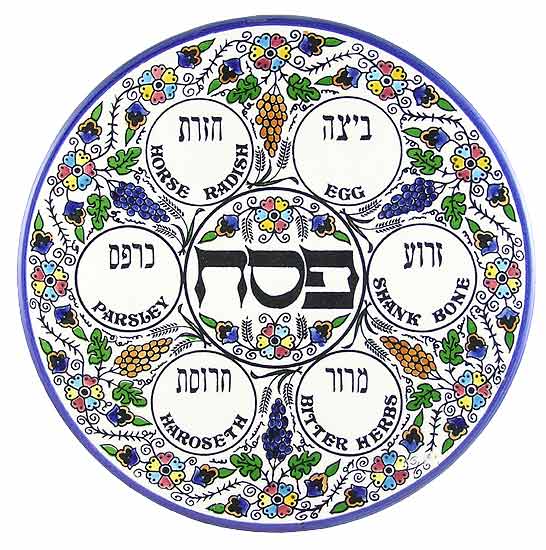
The Seder Plate
We place a Seder Plate at our table as a reminder to discuss certain aspects of the Passover story. Each item has its own significance.
Maror – The bitter herb. This symbolizes the harshness of lives of the Jews in Egypt.
Charoset – A delicious mix of sweet wine, apples, cinnamon and nuts that resembles the mortar used as bricks of the many buildings the Jewish slaves built in Egypt
Karpas – A green vegetable, usually parsley, is a reminder of the green sprouting up all around us during spring and is used to dip into the saltwater
Zeroah – A roasted lamb or shank bone symbolizing the sacrifice made at the great temple on Passover (The Paschal Lamb)
Beitzah – The egg symbolizes a different holiday offering that was brought to the temple. Since eggs are the first item offered to a mourner after a funeral, some say it also evokes a sense of mourning for the destruction of the temple.
Orange - The orange on the seder plate has come to symbolize full inclusion in modern day Judaism: not only for women, but also for people with disabilities, intermarried couples, and the LGBT Community.
Matzah
Matzah is the unleavened bread we eat to remember that when the jews fled Egypt, they didn’t even have time to let the dough rise on their bread. We commemorate this by removing all bread and bread products from our home during Passover.
Elijah’s Cup
The fifth ceremonial cup of wine poured during the Seder. It is left untouched in honor of Elijah, who, according to tradition, will arrive one day as an unknown guest to herald the advent of the Messiah. During the Seder dinner, biblical verses are read while the door is briefly opened to welcome Elijah. In this way the Seder dinner not only commemorates the historical redemption from Egyptian bondage of the Jewish people but also calls to mind their future redemption when Elijah and the Messiah shall appear.
Miriam’s Cup
Another relatively new Passover tradition is that of Miriam’s cup. The cup is filled with water and placed next to Elijah’s cup. Miriam was the sister of Moses and a prophetess in her own right. After the exodus when the Israelites are wandering through the desert, just as Hashem gave them Manna to eat, legend says that a well of water followed Miriam and it was called ‘Miriam’s Well’. The tradition of Miriam’s cup is meant to honor Miriam’s role in the story of the Jewish people and the spirit of all women, who nurture their families just as Miriam helped sustain the Israelites.
What's on the Table
Preview
More
Pesach is a time of inclusion.
On seder night, there are two moments where we metaphorically open our doors and invite others in. One is at the opening of the Magid portion of the seder, when we say, “All who are hungry come and eat.” There is a beautiful message here: we were once slaves; poor and hungry, and we remember our redemption by sharing what we have with others.
The other, comes towards the end of the seder, when we have the custom of pouring a fifth cup of wine, which we claim is for Elijah the Prophet. This is a statement of faith, a statement that says that although we are a free people, our redemption is not yet complete, and we believe that it will come.
From the most downtrodden to the most celebrated, the message is clear: everyone is welcome and everyone is necessary. Why is it that we go out of our way to include all at our seder table? Perhaps it is because when we make room for others, we have the opportunity to make room for ourselves as well. In fact, the Mishnah (Pesahim 10:5) teaches us that:
בכל דור ודור חייב אדם לראות את עצמו כאילו הוא יצא ממצרים In every generation a person is obligated to see themselves as if they left Egypt
The seder presents us with the obligation of identifying with the generation that left Egypt and internalizing that experience. And through that internalization, we come to feel the redemption as if it was our own as well to - לראות את עצמו. Further, the reliving of the story of the Exodus affords us the opportunity see one’s true self. It is only when we are able to see ourselves clearly, that we are able to be redeemed. But perhaps the only way we are able to see ourselves, is when we are truly able to see those around us. This message of inclusion is Pardes’s message too, and our hope is that this Haggadah Companion which offers something for everyone, will add new meaning to your seder and help bring the Jewish people a little closer together.
Introduction
Preview
More
The Seder
This book is a Hagadah.which means “telling.” Tonight we will be having a seder, which means, “order”.Through this traditionally ordered ritual, we will retell the story of the Israelites’ journey out of Egypt, eat special foods that symbolize Pesach's many messages, and teach each other the traditions of Pesach, first celebrated more than 3,000 years ago.
An ancient rabbinic text instructs us, “Each person in every generation must regard himself or herself as having been personally freed from Egypt.” for the seder to be successful.
Tonight’s Seder is not just the retelling of an ancient story.Rather, we are asked to actually experience and acknowledge the bitterness of oppression and the sweetness of freedom so we may better understand the hope and courage of all men and women, of all generations, in their quest for liberty, security, and human rights. This haggadah attempts to incorporate the lives and work of each guest, and to relate the traditional story of passover to our personal experiences and to the modern world around us.
In the words of Audre Lorde: I cannot afford the luxury of fighting one form of oppression only. I cannot afford to believe that freedom from intolerance is the right of only one particular group. And I cannot afford to choose between the fronts upon which I must battle these forces of discrimination, .wherever they appear to destroy me. And when they appear to destroy me, it will not be long before they appear to destroy you.
The order of the seder:
Kadesh-the recitation of Kiddush.
Urchatz-washing the hands.
Karpas-eating a vegetable dipped in salt-water.
Yachatz-breaking of the middle matzo.
Maggid-the recitation of the Hagadah.
Rachtzah-washing of the hands a second time.
Motze-the recitation of the blessing hamotzi.
Matzah-the recitation of the blessing al Achilas matzo, eating the matzo.
Morror-eating the bitter herbs.
Korech-eating a sandwich of matzo and bitter herbs.
Shulchan Oruch-eating the festive meal.
Tzafun-eating the afikomen.
Bayrech-the recitation of grace.
Hallel-the recitation of Hallel psalms of praise
Nirtzah-our prayer that G-d accepts our service.
Introduction
Preview
More
Seder Plate Symbols
Preview
More
Pack Nothing. Bring only your determination to serve and your willingness to be free.
Don’t wait for the bread to rise.
Take nourishment for the journey, but eat standing, be ready to move at a moment’s notice.
Do not hesitate to leave your old ways behind - fear, silence, submission.
Do not take time to explain to the neighbors.Tell only a few trusted friends and family members.
Then begin quickly, before you have time to sink back into the old slavery.
Set out in the dark. I will send fire to warm and encourage you. I will be with you in the fire and I will be with you in the cloud.
You will learn to eat new food and find refuge in new places.
I will give you dreams in the desert to guide you safely home to that place you have not yet seen.
The stories you tell one another around your fires in the dark will make you strong and wise.
Outsiders will attack you, some will follow you, and at times you will weary and turn on each other from fear and fatigue and blind forgetfulness.
You have been preparing for this for hundreds of years.
I am sending you into the wilderness to make a way and to learn my ways more deeply.
Those who fight you will teach you. Those who fear you will strengthen you. Those who follow you may forget you. Only be faithful. This alone matters.
Some of you will die in the desert, for the way is longer than anyone imagined. Some of you will give birth.
Some will join other tribes along the way,
and some will simply stop and create new families in a welcoming oasis.
Some of you will be so changed by weathers and wanderings that even your closest friends will have to learn your features as though for the first time.
Some of you will not change at all.
Sing songs as you go, and hold close together. You may, at times, grow confused and lose your way.
Continue to call each other by the names I’ve given you to help remember who you are. You will get where you are going by remembering who you are.
Tell your children lest they forget and fall into danger -
remind them even they were not born in freedom but under a bondage they no longer remember, which is still with them, if unseen.
So long ago you fell into slavery, slipped into it unaware, out of hunger and need.
Do not let your children sleep through the journey’s hardship.
Keep them awake and walking on their own feet so that you both remain strong and on course.
So you will be only the first of many waves of deliverance on these desert seas.
Do not go back. I am with you now and I am waiting for you.
Full PDF Here - http://www.jewbelong.com/wp-content/uploads/2016/02/JewBelongHaggadah-1.pdf
Passover Remembered
Preview
More
showing
1-6
of
135
Page
1
of
23