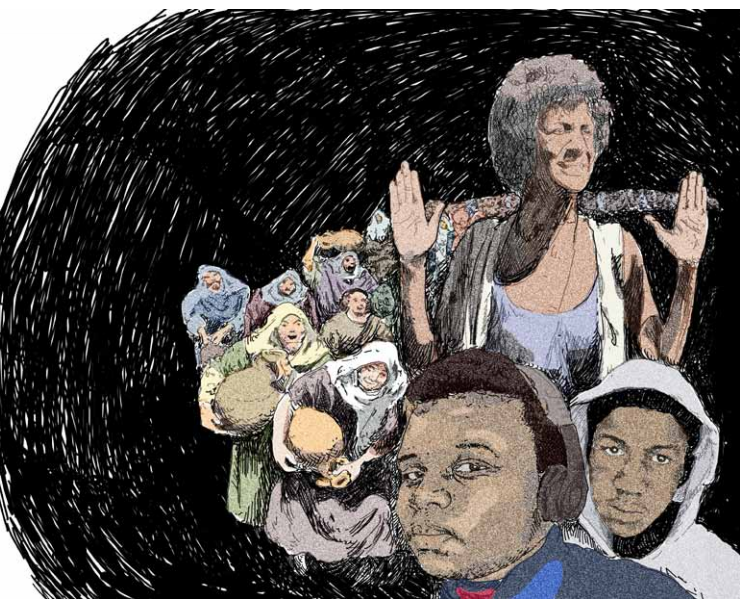
When drinking the four cups and eating the matzah, we lean on our left side to accentuate the fact that we are free people. In ancient times only free people had the luxury of reclining while eating. We ask that this year you consider what it means to recline when so many are not yet free from oppression. This is not a simple question, and so there is no simple answer. In solidarity, you may choose not to recline. Or perhaps we can rest tonight in order to let go of the weight of our fears — our fear of others; of being visible as Jews; of committing to work outside of what is familiar and comfortable — so that we may lean into struggle tomorrow.
“Why on this night when we remember the oppression and resistance of Jews should we also think about the lives of people of color?” Because many Jews are people of color. Because racism is a Jewish issue. Because our liberation is connected.
White Ashkenazi Jews have a rich history but are only a part of the Jewish story. Mizrahi & Sephardi Jews; Yemeni Jews; Ethiopian Jews; Jews who trace their heritage to the Dominican Republic, to Cuba & Mexico; to Guyana & Trinidad; descendants of enslaved Africans whose ancestors converted or whose parents intermarried.
Jews of color are diverse, multihued and proud of it — proud of our Jewishness and proud of our Blackness. But though our lives are joyous and full, racism forces us down a narrow, treacherous path. On the one hand we experience the same oppression that afflicts all people of color in America — racism targets us, our family members, and our friends. On the other hand, the very community that we would turn to for belonging and solidarity — our Jewish community — often doesn’t acknowledge our experience.
Jews of color cannot choose to ignore the experiences of people of color everywhere, anymore than we would ignore our Jewishness. We must fully inhabit both communities and we need all Jews to stand with us, forcefully and actively opposing racism and police violence.
But in order to do so, we must pare our past trauma from our present truth: our history of oppression leaves many of us hyper-vigilant and overly preoccupied with safety. As Jews we share a history that is overburdened with tales of violent oppression. Though different Jewish communities have varying experiences, none of us have escaped painful legacies of persecution, including genocide. This past is real, and part of why we gather today is to remember it. But the past is past. However seductive harsh policing, surveillance and incarceration may be in the short term, it will never serve us in the end. Not when those tactics brutalize other communities, humiliating and incarcerating our neighbors and perpetuate a status quo that leaves low-income communities of color on the other side of a sea of fear — still trapped; still stranded. The only real way out of the Mitzrayim of our fears is solidarity. Only by forging deep connections and sharing struggle with other communities will we creating the lasting allies who will walk with us into the promised land of our collective liberation. That is true Jewish freedom — true and lasting safety.
They cried to Moses, “What have you done to us, taking us out of Egypt ... it is better to serve the Egyptians than to die in the wilderness” (14:11-12).
When Moses led the Jews out of Egypt, it was a moment of great risk and great change. As the passage above shows us, though life under Pharaoh was cruel and crushing, it was also familiar — a known fear. After a century of servitude, freedom. What changed? It was the Jewish people daring to imagine for themselves something greater. Daring to take great risks and face great fears to find liberation. This willingness to stand up for justice is a strength we have found again and again. When the oppression of economic exploitation demanded it, our grandparents found it in the labor movement; when the civil rights movement demanded it, our parents travelled to the South to register voters. Now this moment demands again that we take risks for justice.
What our neighbors in communities of color are asking — what the Jews of color in our own communities need from their fellow Jews — is that we push past the comfortable and move to action. In the streets, in our synagogues and homes, with our voices, our bodies, our money and resources, with our imaginations. In doing so we must center the voices and the leadership of Jews of color and other communities of color, while forming deep partnerships and long-term commitments to fight for lasting change.
Passover is a time of remembrance but also one of renewal — of looking ahead toward the spring and new growth that will sustain us through the seasons to come. Once we spent spring in the desert. It was harsh and difficult but from that journey grew a people who have endured for centuries. What would happen if we took that journey again, not alone in the wilderness but surrounded by friends and allies, leaving no one behind?
As we open the door for the Prophet Elijah, Graie Barasch-Hagans asks us to love and support the stranger, the beggar and the familial in our struggle for collective liberation, and to recognize that these three peoples are often one and the same.
As Jews we come together in our most vulnerable moments. We come as community to support our mourners in our synagogues and in our homes. As Black folks we have come to the street, to the courthouse, to the town square to demand justice.
Our demands for justice are a communal act to love and support one another. A communal act to remember those who have been taken from us.
We have no kaddish, no framework of remembrance. We have hashtags, freedom songs, and protest chants.
When we say Black Lives Matter we are calling for the recognition of G-d in us all. We are calling for our skin to be recognized as the skin of family, our tears to be recognized as the tears of mothers, of fathers, of lovers, the tears of G-d.
We are a people who know that there is a better world and that it our responsibility, our duty to love and support one another. The stranger, the beggar, and the familial.
For those of us who live our lives through Blackness we cannot separate our duty as Jews from our fears of being strange in a land that though of our birth still does not recognize us fully as present. As Jews who cannot separate from our Blackness we inhabit spaces of silent loss. We struggle to rise as mourners in spaces that call for us to remember our time as slaves in Egypt. To remember that we are not safe as Jews. That are inhabited by the call “Never Again.”
For we are the descendants of slaves with no great escape story. No great memorial to our suffering. No great G-d to intervene on our behalf, to choose us, to form us as a people. And yet for many of us who inhabit both Blackness and Jewishness we feel the deep divide, as the parting of the seas. For if our images of our great escape maintain the dichotomy of light versus dark would the sea fall in on us? Would we be cast aside, swept away in the great tide? Would we be held tight and carried with as much as care as the bread we did not have time to rise? As so many with faces with skin so similar to mine remain in bondage, in isolation, removed from a people still struggling will we return to the voice of “we” in our demand to Let my people go?
This piece has been edited for this edition. A fuller version can be found at blacklivesmatteronpassover.com
Why Black Lives Matter to a People for Whom G-d Promised a Holy Place
Preview
More
A small piece of onion, parsley, or boiled potato is dipped into saltwater and eaten (after reciting the blessing over vegetables). Dipping the karpas is a sign of luxury and freedom. The saltwater represents the tears of our ancestors in Mitzrayim. This year may it also represent tears of Black parents and families mourning the loss of their Black youth at the hands of police brutality.
Do we all truly know that Black lives matter?
Go Down Moses is a Negro Spiritual, originally sung by enslaved Africans in the American South. It describes the Exodus story and so it has become common for Jews to sing it during the Seder. As we use the beautiful songs of Black people to enrich our Jewish traditions, Evan Traylor asks you to reflect on what it means to sing a song of freedom when so many are not free.
On this Passover, as we remind ourselves of the preciousness of freedom, let us be reminded that we are not all free. Black people in the United States continue to suffer from oppression. And while Black people are not physically enslaved as during the dark part of our nation’s history, they still suffer from education inequality, mass incarceration, police brutality, and other forms of both blatant and subtle racism.
Do we all truly know that Black lives matter?
Just as during the Exodus story, may all of us have the leadership of Moses, the spirit of Miriam, and the undying courage of Nachshon to stand with Black people and ensure that everyone knows and believes that Black lives matter. Just as the Israelites did not turn back from the Red Sea, we must not turn back from the enormous challenges that are wounding and killing Black people in the United States. Mirroring the Israelites crossing the Red Sea with danger at their backs, we too must join hands, face the challenges, and overcome. Through faith and fellowship, we shall overcome.
We gather on Passover to recall a moment of resistance and liberation in the history of our people. The story of Exodus reminds us of the transformative power that our people wield when we confront oppression. This summer we witnessed the deaths of Michael Brown and Eric Garner at the hands of the police; in the months that followed the #BlackLivesMatter movement blossomed from that stained soil and swept the country. From Ferguson to Staten Island, Black people resisted the discriminatory and abusive policing targeting them. #BlackLivesMatter, a term coined by activists Alicia Garza, Patrice Cullors & Opal Tometi, demands that we recognize the full humanity and precious value of every individual Black life — that we cherish and fight for all people of African heritage. In this spirit, Jews For Racial & Economic Justice collaborated with inspiring activists and leaders from around the country to produce this Haggadah supplement. In it you will find additions to the Seder rituals & Haggadah text intended to highlight the role we believe Jews must play in confronting racism and abusive policing. Each piece of the supplement may provoke discussion, reflection or even contention. We hope that this wrestling, thinking and feeling — in the great tradition of our people — will be a powerful part of your Seder and will lead to meaningful action for justice.
When drinking the four cups and eating the matzah, we lean on our left side to accentuate the fact that we are free people. In ancient times only free people had the luxury of reclining while eating. We ask that this year you consider what it means to recline when so many are not yet free from oppression. This is not a simple question, and so there is no simple answer. In solidarity, you may choose not to recline. Or perhaps we can rest tonight in order to let go of the weight of our fears — our fear of others; of being visible as Jews; of committing to work outside of what is familiar and comfortable — so that we may lean into struggle tomorrow.
“Why on this night when we remember the oppression and resistance of Jews should we also think about the lives of people of color?” Because many Jews are people of color. Because racism is a Jewish issue. Because our liberation is connected.
White Ashkenazi Jews have a rich history but are only a part of the Jewish story. Mizrahi & Sephardi Jews; Yemeni Jews; Ethiopian Jews; Jews who trace their heritage to the Dominican Republic, to Cuba & Mexico; to Guyana & Trinidad; descendants of enslaved Africans whose ancestors converted or whose parents intermarried.
Jews of color are diverse, multihued and proud of it — proud of our Jewishness and proud of our Blackness. But though our lives are joyous and full, racism forces us down a narrow, treacherous path. On the one hand we experience the same oppression that afflicts all people of color in America — racism targets us, our family members, and our friends. On the other hand, the very community that we would turn to for belonging and solidarity — our Jewish community — often doesn’t acknowledge our experience.
Jews of color cannot choose to ignore the experiences of people of color everywhere, anymore than we would ignore our Jewishness. We must fully inhabit both communities and we need all Jews to stand with us, forcefully and actively opposing racism and police violence.
But in order to do so, we must pare our past trauma from our present truth: our history of oppression leaves many of us hyper-vigilant and overly preoccupied with safety. As Jews we share a history that is overburdened with tales of violent oppression. Though different Jewish communities have varying experiences, none of us have escaped painful legacies of persecution, including genocide. This past is real, and part of why we gather today is to remember it. But the past is past. However seductive harsh policing, surveillance and incarceration may be in the short term, it will never serve us in the end. Not when those tactics brutalize other communities, humiliating and incarcerating our neighbors and perpetuate a status quo that leaves low-income communities of color on the other side of a sea of fear — still trapped; still stranded. The only real way out of the Mitzrayim of our fears is solidarity. Only by forging deep connections and sharing struggle with other communities will we creating the lasting allies who will walk with us into the promised land of our collective liberation. That is true Jewish freedom — true and lasting safety.
They cried to Moses, “What have you done to us, taking us out of Egypt ... it is better to serve the Egyptians than to die in the wilderness” (14:11-12).
When Moses led the Jews out of Egypt, it was a moment of great risk and great change. As the passage above shows us, though life under Pharaoh was cruel and crushing, it was also familiar — a known fear. After a century of servitude, freedom. What changed? It was the Jewish people daring to imagine for themselves something greater. Daring to take great risks and face great fears to find liberation. This willingness to stand up for justice is a strength we have found again and again. When the oppression of economic exploitation demanded it, our grandparents found it in the labor movement; when the civil rights movement demanded it, our parents travelled to the South to register voters. Now this moment demands again that we take risks for justice.
What our neighbors in communities of color are asking — what the Jews of color in our own communities need from their fellow Jews — is that we push past the comfortable and move to action. In the streets, in our synagogues and homes, with our voices, our bodies, our money and resources, with our imaginations. In doing so we must center the voices and the leadership of Jews of color and other communities of color, while forming deep partnerships and long-term commitments to fight for lasting change.
Passover is a time of remembrance but also one of renewal — of looking ahead toward the spring and new growth that will sustain us through the seasons to come. Once we spent spring in the desert. It was harsh and difficult but from that journey grew a people who have endured for centuries. What would happen if we took that journey again, not alone in the wilderness but surrounded by friends and allies, leaving no one behind?
As we open the door for the Prophet Elijah, Graie Barasch-Hagans asks us to love and support the stranger, the beggar and the familial in our struggle for collective liberation, and to recognize that these three peoples are often one and the same.
As Jews we come together in our most vulnerable moments. We come as community to support our mourners in our synagogues and in our homes. As Black folks we have come to the street, to the courthouse, to the town square to demand justice.
Our demands for justice are a communal act to love and support one another. A communal act to remember those who have been taken from us.
We have no kaddish, no framework of remembrance. We have hashtags, freedom songs, and protest chants.
When we say Black Lives Matter we are calling for the recognition of G-d in us all. We are calling for our skin to be recognized as the skin of family, our tears to be recognized as the tears of mothers, of fathers, of lovers, the tears of G-d.
We are a people who know that there is a better world and that it our responsibility, our duty to love and support one another. The stranger, the beggar, and the familial.
For those of us who live our lives through Blackness we cannot separate our duty as Jews from our fears of being strange in a land that though of our birth still does not recognize us fully as present. As Jews who cannot separate from our Blackness we inhabit spaces of silent loss. We struggle to rise as mourners in spaces that call for us to remember our time as slaves in Egypt. To remember that we are not safe as Jews. That are inhabited by the call “Never Again.”
For we are the descendants of slaves with no great escape story. No great memorial to our suffering. No great G-d to intervene on our behalf, to choose us, to form us as a people. And yet for many of us who inhabit both Blackness and Jewishness we feel the deep divide, as the parting of the seas. For if our images of our great escape maintain the dichotomy of light versus dark would the sea fall in on us? Would we be cast aside, swept away in the great tide? Would we be held tight and carried with as much as care as the bread we did not have time to rise? As so many with faces with skin so similar to mine remain in bondage, in isolation, removed from a people still struggling will we return to the voice of “we” in our demand to Let my people go?
This piece has been edited for this edition. A fuller version can be found at blacklivesmatteronpassover.com
Why Black Lives Matter to a People for Whom G-d Promised a Holy Place
Preview
More
A small piece of onion, parsley, or boiled potato is dipped into saltwater and eaten (after reciting the blessing over vegetables). Dipping the karpas is a sign of luxury and freedom. The saltwater represents the tears of our ancestors in Mitzrayim. This year may it also represent tears of Black parents and families mourning the loss of their Black youth at the hands of police brutality.
Do we all truly know that Black lives matter?
Go Down Moses is a Negro Spiritual, originally sung by enslaved Africans in the American South. It describes the Exodus story and so it has become common for Jews to sing it during the Seder. As we use the beautiful songs of Black people to enrich our Jewish traditions, Evan Traylor asks you to reflect on what it means to sing a song of freedom when so many are not free.
On this Passover, as we remind ourselves of the preciousness of freedom, let us be reminded that we are not all free. Black people in the United States continue to suffer from oppression. And while Black people are not physically enslaved as during the dark part of our nation’s history, they still suffer from education inequality, mass incarceration, police brutality, and other forms of both blatant and subtle racism.
Do we all truly know that Black lives matter?
Just as during the Exodus story, may all of us have the leadership of Moses, the spirit of Miriam, and the undying courage of Nachshon to stand with Black people and ensure that everyone knows and believes that Black lives matter. Just as the Israelites did not turn back from the Red Sea, we must not turn back from the enormous challenges that are wounding and killing Black people in the United States. Mirroring the Israelites crossing the Red Sea with danger at their backs, we too must join hands, face the challenges, and overcome. Through faith and fellowship, we shall overcome.
We gather on Passover to recall a moment of resistance and liberation in the history of our people. The story of Exodus reminds us of the transformative power that our people wield when we confront oppression. This summer we witnessed the deaths of Michael Brown and Eric Garner at the hands of the police; in the months that followed the #BlackLivesMatter movement blossomed from that stained soil and swept the country. From Ferguson to Staten Island, Black people resisted the discriminatory and abusive policing targeting them. #BlackLivesMatter, a term coined by activists Alicia Garza, Patrice Cullors & Opal Tometi, demands that we recognize the full humanity and precious value of every individual Black life — that we cherish and fight for all people of African heritage. In this spirit, Jews For Racial & Economic Justice collaborated with inspiring activists and leaders from around the country to produce this Haggadah supplement. In it you will find additions to the Seder rituals & Haggadah text intended to highlight the role we believe Jews must play in confronting racism and abusive policing. Each piece of the supplement may provoke discussion, reflection or even contention. We hope that this wrestling, thinking and feeling — in the great tradition of our people — will be a powerful part of your Seder and will lead to meaningful action for justice.
showing
1-6
of
10
Page
1
of
2