For Ashkenazi Jews, the primary symbolic food of Rosh Ha-Shanah is apples dipped in honey, a way of wishing for a sweet new year. Before eating apples and honey, say the following blessings:
Barukh atah Adonai Eloheinu melekh ha'olam borei pri ha-eitz.
Blessed are You, God, Ruler of the universe, who creates fruit of the tree.
Yehi ratzon lifanecha, Adonai Eloheinu, v'Elohai avoteinu, she'te'hadesh aleinu shanah tovah u'metukah.
May it be Your will, Adonai our God, to grant us a good and sweet year.
Recipe by Paige Erlich
I love cooking and hosting events so much that I’ve turned it into a side hobby, sharing my favorite recipes and hosting tips on Instagram at @PaigePlates. When hosting Shabbat dinner or picnicking in the park with my friends, I’m particularly fond of sharing charcuterie or cheese boards, which are fun to both make and eat. And while they’re so beautiful that they always look impressive, they’re fairly easy to assemble – especially with a little bit of forethought and planning.
I always like to choose a theme for my cheese boards, and as it turns out, Rosh HaShanah is a built-in theme! Traditional holiday foods like apples, honey, dates, figs, and pomegranates are all perfect for cheese boards, and each pairs nicely with various cheeses.
Here’s how to go about creating your own Rosh HaShanah cheese board, whether to serve as a holiday appetizer or a lunchtime indulgence during the Yamim Noraim.
First, choose your cheeses. Lots of varieties of cheese pair well with apples and honey, so you have plenty to choose from. I'm no expert, but I recommend choosing three to four types (depending on the size of your cheese board) that vary in degrees hardness and softness.
I chose three cheeses, two hard and one soft: manchego, which is popularly paired with honey; white cheddar, which complements the crisp tartness of apples; and Brie, a soft cheese that goes well with just about everything. You may wish to use goat cheese, blue cheese, gouda… truly, the combinations are endless, and the good news is that all of them will taste great.
Jewish cooking expert Tina Wasserman explains, “Apples and honey: For Ashkenazi Jews, these words are an inseparable pairing. We dip a slice of apple in honey to express our hopes for a sweet and fruitful year.”
For your cheese board, choose whatever kind of apples you like best or find in season – or even pick your own at an orchard! I went with my favorites, Red Delicious, and arranged them in a long, swirling design as the vibrant centerpiece of my cheeseboard.
I put a small bowl of honey on my cheese board, complete with a little honey stick, both for show and for functionality. I recommend getting creative with different types of honey, mixing up the kinds (wildflower, raw, etc.), flavors (spicy, lavender, etc.) and even the hues.
Another special treat, and one that I love using on cheeseboards, is honeycomb, which is completely edible, oozes with honey, and lends an interesting, chewy texture. I purchase mine from a local company (with thanks to Busy Bees NJ) for a special Rosh HaShanah touch on my holiday cheese boards.
I wanted to add a few other Rosh HaShanah and fall-themed food elements to my cheeseboard, so I turned to figs and pomegranates.
At Rosh HaShanah, we eat “new fruits,” those that have just ripened with the coming of the season. Figs are one such fruit, only in season for a short amount of time in late summer and early fall. They’re delicious and look beautiful on a cheese board board, adding color and texture; importantly, they also pair well with both cheese and honey.
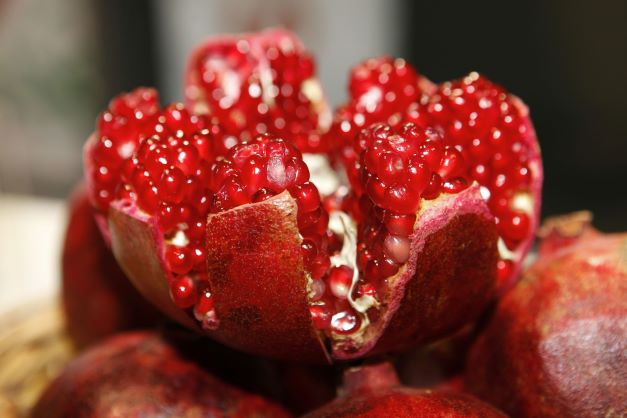
Pomegranates are commonly associated with Judaism because they are thought to contain 613 seeds, the same number of mitzvot (commandments) we find in the Torah. Chris Harrison writes, “This allegory encourages us to fulfill mitzvot and live righteous lives.” Cut open a pomegranate to add color, texture, and sweet, juicy bursts of flavor to your holiday cheese board.
I didn't use dates on my cheese board, but they're often found on the Sephardic seder plate this time of year, and they're another possible addition. Tamar, or “date” in Hebrew, is similar to the word yitamu, which means “to end.” In addition to its sweetness, the date wishes an “end” to those who wish us ill will. Sweet dates make for a great, textured addition to your Rosh HaShanah cheese board.
Cheese and fruit both pair well with a variety of nuts, which fill up space on your cheese board and add a little bit of protein. When the rest of my board elements were in place, I filled up the remaining nooks and crannies with walnuts.
Sephardic Jews often enjoy tispishti, a walnut cake with sweet syrup, to celebrate the Jewish new year, which make walnuts a nice and traditional choice for a Rosh HaShanah cheese board. You can also try pecans, almonds, pistachios, or anything else that sounds good to you.
While I chose to feature honey as the star of my cheese board, other condiments like jams, jellies, preserves, and chutneys can make for a tasty addition, too.
To stick with the Rosh HaShanah theme, consider options like fig jam, apple butter, quince paste, pomegranate spread, or even homemade dulce de manzana (apple preserves). If you want to go in a more Sephardic direction, you can incorporate flavors like pumpkin ( k’ra ), traditionally consumed at the start of the new year – and also very much in keeping with the autumn season!
Don’t forget to add some crackers to your cheese board to make it easy to create tiny, handheld bites. Simply choose whatever cracker(s) you like best! I went with round multigrain crackers, but you can also add any other type of cracker, pretzel crisps, pita chips, bagel chips, dried fruit- and nut-studded crisps…… whatever suits your fancy.
You can also set out a traditional round challah to use instead or in addition to crackers.
Once you’ve chosen all of the elements of your cheese board get to work assembling it in a way that’s creative and beautiful – and then go wild creating your own small bites with various combinations of ingredients. Here are a few I love:
What combinations will you choose? If you create your own Rosh HaShanah masterpiece, be sure to tag us on social media (we’re @ReformJudaism on Twitter, Facebook, and Instagram) so we can ooh and ahh over your creation!
Lilya's Summer Beet Borscht
Liz Alpern, Co-Founder of the Gefilteria introduces this recipe: One summer day, Jeffrey and I headed to Little Odessa in Brighton Beach, Brooklyn. We were visiting our business partner Jackie’s ninety-two-year-old Russian-born great-aunt, Lilya. She had immigrated to Brighton Beach from the Soviet Union in 1989. Lilya was known for her borscht, and she’d invited us to spend time with her while she salted and seasoned three varieties of the soup.
SERVES 6 TO 8
Ingredients
2 pounds whole beets, scrubbed but unpeeled
2 carrots, unpeeled and coarsely chopped
2 celery stalks with leaves, coarsely chopped
2 medium onions:
1 quartered, 1 diced
5 garlic cloves: 2 left whole, 3 minced
2 dried bay leaves
2 tablespoons kosher salt
2 tablespoons whole black peppercorns
2 tablespoons caraway seeds
4 cups cold water
2 tablespoons olive oil
3 tablespoons honey
3 tablespoons apple cider vinegar
Sour cream, store-bought or homemade (page 24), or crème fraîche, for garnish
Chopped fresh dill, for garnish
Instructions
1. Preheat the oven to 400oF. Wrap 1 pound of the beets individually in aluminum foil and set on a baking sheet. Roast until they can be easily pierced with a fork, 40 minutes to 1 hour, depending on the size of the beets (larger beets take longer). The skin should peel off easily under cold running water. Dice the beets into bite-size pieces and refrigerate until serving.
2. While the beets are roasting, in a large soup pot, combine the remaining 1 pound beets, the carrots, celery, quartered onion, whole garlic cloves, bay leaves, salt, peppercorns, caraway seeds and 9 cups of water. Bring to a boil, then reduce the heat to low and simmer for 1 hour. Remove from the heat.
3. Fill a large bowl with water and ice. Remove the boiled beets from the pot and place them in the ice-water bath. When cool, peel and coarsely chop them. Strain the broth through a fine-mesh strainer into a large bowl, discarding the solids.
4. Rinse and dry the soup pot and set it over medium heat. Add the olive oil and diced onion and sauté until the onion is fragrant, about 3 minutes. Add the minced garlic and sauté for 3 to 5 minutes more, until the onion begins to turn golden. Add the beet broth and coarsely chopped boiled beets to the pot and simmer over low heat, covered, for about 20 minutes.
5. Remove from the heat and puree the soup in the pot using an immersion blender. (Alternatively, transfer it in small batches to a standing blender and puree—just be careful!) Add the honey and vinegar and simmer over very low heat for 5 minutes.
6. If serving hot, place 2 tablespoons of diced roasted beets in the bottom of each bowl and then ladle the hot soup over them. Garnishing with sour cream and chopped fresh dill. If serving chilled, remove from the heat and let the soup cool completely and then refrigerate overnight. Be sure to stir the soup well and taste immediately before serving. Once cooled, many soups require a touch more salt. If necessary, add more salt, a teaspoon at a time. As with hot borscht, place 2 tablespoons of the roasted beets at the bottom of the bowl and ladle the soup on top. Serve garnished with sour cream and chopped fresh dill.
Excerpted from the book THE GEFILTE MANIFESTO by Jeffrey Yoskowitz & Liz Alpern. Copyright © 2016 by Gefilte Manifesto LLC. Reprinted with permission from Flatiron Books. All rights reserved. Photography by Lauren Volo.
Baruch ata Adonai, Eloheinu melech haolam,borei p’ri hagafen.
We bless You, Eternal God, Sovereign of the universe, Creator of the fruit of the vine.
For Ashkenazi Jews, the primary symbolic food of Rosh Ha-Shanah is apples dipped in honey, a way of wishing for a sweet new year. Before eating apples and honey, say the following blessings:
Barukh atah Adonai Eloheinu melekh ha'olam borei pri ha-eitz.
Blessed are You, God, Ruler of the universe, who creates fruit of the tree.
Yehi ratzon lifanecha, Adonai Eloheinu, v'Elohai avoteinu, she'te'hadesh aleinu shanah tovah u'metukah.
May it be Your will, Adonai our God, to grant us a good and sweet year.
Recipe by Paige Erlich
I love cooking and hosting events so much that I’ve turned it into a side hobby, sharing my favorite recipes and hosting tips on Instagram at @PaigePlates. When hosting Shabbat dinner or picnicking in the park with my friends, I’m particularly fond of sharing charcuterie or cheese boards, which are fun to both make and eat. And while they’re so beautiful that they always look impressive, they’re fairly easy to assemble – especially with a little bit of forethought and planning.
I always like to choose a theme for my cheese boards, and as it turns out, Rosh HaShanah is a built-in theme! Traditional holiday foods like apples, honey, dates, figs, and pomegranates are all perfect for cheese boards, and each pairs nicely with various cheeses.
Here’s how to go about creating your own Rosh HaShanah cheese board, whether to serve as a holiday appetizer or a lunchtime indulgence during the Yamim Noraim.
First, choose your cheeses. Lots of varieties of cheese pair well with apples and honey, so you have plenty to choose from. I'm no expert, but I recommend choosing three to four types (depending on the size of your cheese board) that vary in degrees hardness and softness.
I chose three cheeses, two hard and one soft: manchego, which is popularly paired with honey; white cheddar, which complements the crisp tartness of apples; and Brie, a soft cheese that goes well with just about everything. You may wish to use goat cheese, blue cheese, gouda… truly, the combinations are endless, and the good news is that all of them will taste great.
Jewish cooking expert Tina Wasserman explains, “Apples and honey: For Ashkenazi Jews, these words are an inseparable pairing. We dip a slice of apple in honey to express our hopes for a sweet and fruitful year.”
For your cheese board, choose whatever kind of apples you like best or find in season – or even pick your own at an orchard! I went with my favorites, Red Delicious, and arranged them in a long, swirling design as the vibrant centerpiece of my cheeseboard.
I put a small bowl of honey on my cheese board, complete with a little honey stick, both for show and for functionality. I recommend getting creative with different types of honey, mixing up the kinds (wildflower, raw, etc.), flavors (spicy, lavender, etc.) and even the hues.
Another special treat, and one that I love using on cheeseboards, is honeycomb, which is completely edible, oozes with honey, and lends an interesting, chewy texture. I purchase mine from a local company (with thanks to Busy Bees NJ) for a special Rosh HaShanah touch on my holiday cheese boards.
I wanted to add a few other Rosh HaShanah and fall-themed food elements to my cheeseboard, so I turned to figs and pomegranates.
At Rosh HaShanah, we eat “new fruits,” those that have just ripened with the coming of the season. Figs are one such fruit, only in season for a short amount of time in late summer and early fall. They’re delicious and look beautiful on a cheese board board, adding color and texture; importantly, they also pair well with both cheese and honey.
Pomegranates are commonly associated with Judaism because they are thought to contain 613 seeds, the same number of mitzvot (commandments) we find in the Torah. Chris Harrison writes, “This allegory encourages us to fulfill mitzvot and live righteous lives.” Cut open a pomegranate to add color, texture, and sweet, juicy bursts of flavor to your holiday cheese board.
I didn't use dates on my cheese board, but they're often found on the Sephardic seder plate this time of year, and they're another possible addition. Tamar, or “date” in Hebrew, is similar to the word yitamu, which means “to end.” In addition to its sweetness, the date wishes an “end” to those who wish us ill will. Sweet dates make for a great, textured addition to your Rosh HaShanah cheese board.
Cheese and fruit both pair well with a variety of nuts, which fill up space on your cheese board and add a little bit of protein. When the rest of my board elements were in place, I filled up the remaining nooks and crannies with walnuts.
Sephardic Jews often enjoy tispishti, a walnut cake with sweet syrup, to celebrate the Jewish new year, which make walnuts a nice and traditional choice for a Rosh HaShanah cheese board. You can also try pecans, almonds, pistachios, or anything else that sounds good to you.
While I chose to feature honey as the star of my cheese board, other condiments like jams, jellies, preserves, and chutneys can make for a tasty addition, too.
To stick with the Rosh HaShanah theme, consider options like fig jam, apple butter, quince paste, pomegranate spread, or even homemade dulce de manzana (apple preserves). If you want to go in a more Sephardic direction, you can incorporate flavors like pumpkin ( k’ra ), traditionally consumed at the start of the new year – and also very much in keeping with the autumn season!
Don’t forget to add some crackers to your cheese board to make it easy to create tiny, handheld bites. Simply choose whatever cracker(s) you like best! I went with round multigrain crackers, but you can also add any other type of cracker, pretzel crisps, pita chips, bagel chips, dried fruit- and nut-studded crisps…… whatever suits your fancy.
You can also set out a traditional round challah to use instead or in addition to crackers.
Once you’ve chosen all of the elements of your cheese board get to work assembling it in a way that’s creative and beautiful – and then go wild creating your own small bites with various combinations of ingredients. Here are a few I love:
What combinations will you choose? If you create your own Rosh HaShanah masterpiece, be sure to tag us on social media (we’re @ReformJudaism on Twitter, Facebook, and Instagram) so we can ooh and ahh over your creation!
Lilya's Summer Beet Borscht
Liz Alpern, Co-Founder of the Gefilteria introduces this recipe: One summer day, Jeffrey and I headed to Little Odessa in Brighton Beach, Brooklyn. We were visiting our business partner Jackie’s ninety-two-year-old Russian-born great-aunt, Lilya. She had immigrated to Brighton Beach from the Soviet Union in 1989. Lilya was known for her borscht, and she’d invited us to spend time with her while she salted and seasoned three varieties of the soup.
SERVES 6 TO 8
Ingredients
2 pounds whole beets, scrubbed but unpeeled
2 carrots, unpeeled and coarsely chopped
2 celery stalks with leaves, coarsely chopped
2 medium onions:
1 quartered, 1 diced
5 garlic cloves: 2 left whole, 3 minced
2 dried bay leaves
2 tablespoons kosher salt
2 tablespoons whole black peppercorns
2 tablespoons caraway seeds
4 cups cold water
2 tablespoons olive oil
3 tablespoons honey
3 tablespoons apple cider vinegar
Sour cream, store-bought or homemade (page 24), or crème fraîche, for garnish
Chopped fresh dill, for garnish
Instructions
1. Preheat the oven to 400oF. Wrap 1 pound of the beets individually in aluminum foil and set on a baking sheet. Roast until they can be easily pierced with a fork, 40 minutes to 1 hour, depending on the size of the beets (larger beets take longer). The skin should peel off easily under cold running water. Dice the beets into bite-size pieces and refrigerate until serving.
2. While the beets are roasting, in a large soup pot, combine the remaining 1 pound beets, the carrots, celery, quartered onion, whole garlic cloves, bay leaves, salt, peppercorns, caraway seeds and 9 cups of water. Bring to a boil, then reduce the heat to low and simmer for 1 hour. Remove from the heat.
3. Fill a large bowl with water and ice. Remove the boiled beets from the pot and place them in the ice-water bath. When cool, peel and coarsely chop them. Strain the broth through a fine-mesh strainer into a large bowl, discarding the solids.
4. Rinse and dry the soup pot and set it over medium heat. Add the olive oil and diced onion and sauté until the onion is fragrant, about 3 minutes. Add the minced garlic and sauté for 3 to 5 minutes more, until the onion begins to turn golden. Add the beet broth and coarsely chopped boiled beets to the pot and simmer over low heat, covered, for about 20 minutes.
5. Remove from the heat and puree the soup in the pot using an immersion blender. (Alternatively, transfer it in small batches to a standing blender and puree—just be careful!) Add the honey and vinegar and simmer over very low heat for 5 minutes.
6. If serving hot, place 2 tablespoons of diced roasted beets in the bottom of each bowl and then ladle the hot soup over them. Garnishing with sour cream and chopped fresh dill. If serving chilled, remove from the heat and let the soup cool completely and then refrigerate overnight. Be sure to stir the soup well and taste immediately before serving. Once cooled, many soups require a touch more salt. If necessary, add more salt, a teaspoon at a time. As with hot borscht, place 2 tablespoons of the roasted beets at the bottom of the bowl and ladle the soup on top. Serve garnished with sour cream and chopped fresh dill.
Excerpted from the book THE GEFILTE MANIFESTO by Jeffrey Yoskowitz & Liz Alpern. Copyright © 2016 by Gefilte Manifesto LLC. Reprinted with permission from Flatiron Books. All rights reserved. Photography by Lauren Volo.
Baruch ata Adonai, Eloheinu melech haolam,borei p’ri hagafen.
We bless You, Eternal God, Sovereign of the universe, Creator of the fruit of the vine.
showing
1-6
of
30
Page
1
of
5